Women In Supply Chain™ leadership are transforming the industry when it’s needed most during endless disruptions that have only exacerbated over the last year, rattled by climate change, geopolitical tensions, and an all-out tariff war. The same rinse-and-repeat approaches don’t apply anymore, and that means that fresh perspectives and diversity in thought are increasingly important.
On the policy front, there may be some good news as we enter peak season. The U.S. doubled tariffs on imports from India to 50% at the end of August; however, there may be some relief on the way. The current administration may remove 25% of the penal tariffs after November 30th, with trade discussions ongoing. U.S. goods imported from India totaled around $87.3B last year, according to the United States Trade Representative (USTR). That’s a big chunk of the total bilateral trade between the U.S. and India at $128.9B. You might think of clothing goods made in India, but trade between the two countries goes far beyond that. Critical imports of goods from India include electronics and electric equipment, pharmaceutical products, precious stones and metals, machinery, and nuclear reactors and boilers.
The United States and China are still in a temporary tariff truce, suspending steeper tariffs on Chinese goods until at least November 10th—spurring more companies to frontload shipments moving into the holiday season. The Trump administration has signaled that it may be amenable to extending the pause further as the nations work to negotiate. Ongoing trade negotiations between the U.S. and other countries bode well for global supply chains that have experienced historical disruptions over the past months.
Market volatility underscores the importance of having a diverse range of thought in supply chain. It’s time to innovate and bring together new voices from different backgrounds with different perspectives and knowledge sets—including women’s. Because with the industry all but upended by the “new normal,” just 26% of Women In Supply Chain™ leadership is simply not enough.
At Let’s Talk Supply Chain, our Women In Supply Chain™ series is more than a call to action; it’s a movement. There’s a growing workforce of Women In Supply Chain™ who see and approach things differently, and have new strategies and flavors of leadership. Our Let’s Talk Supply Chain Women In Supply Chain™ program, blog, and podcast series showcase the importance of greater gender representation. This month’s featured leader knows all about the importance of allyship in lifting women’s voices.
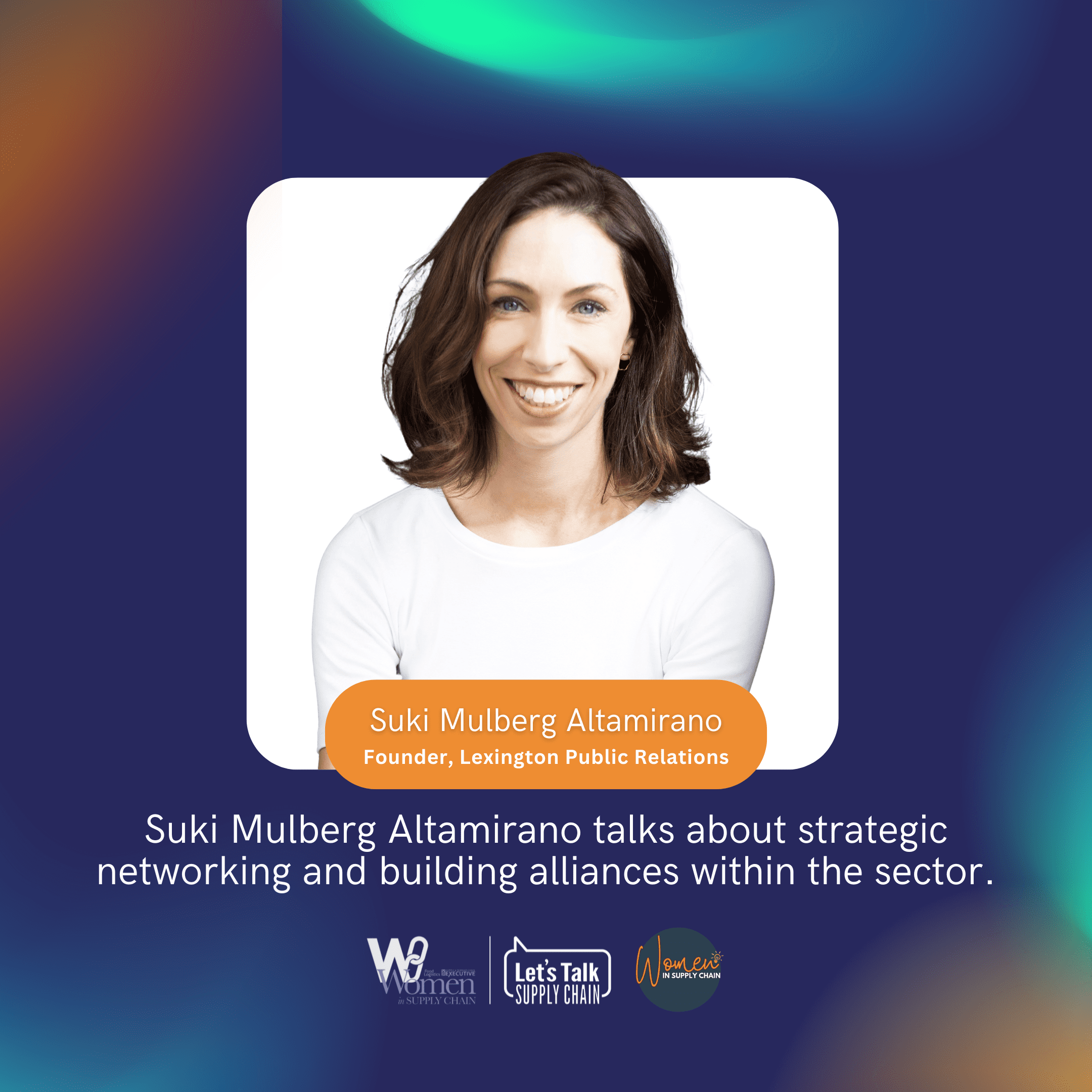
We are proud to feature Suki Mulberg Altamirano, the Founder & Principal of Lexington Public Relations. For over two decades, she’s crafted storytelling into bold campaigns to drive brand authority, visibility, and credibility, winning awards along the way. Lexington PR was hailed by the American Business Awards with its gold Communications/PR Agency Merit Award for 2024. She is a published author and earned a Bachelor of Science in Communications and Media Studies from New York University.
1. How did your supply chain journey start?
My journey began in New York City with my first role at LVMH, followed by in-house PR positions at Elizabeth Arden and Williams-Sonoma, where I honed my storytelling skills in lifestyle sectors. Fourteen years ago, I founded Lexington Public Relations, initially focusing on fashion, beauty, food, and lifestyle brands —a natural extension of my early career experience. The pivotal shift came through a VC firm’s introduction to portfolio clients across an array of new industries, including edtech, healthcare technology, and more.
I almost hesitated because it felt so out of my wheelhouse, but that decision to embrace unfamiliar territory opened entirely new possibilities. Those clients led to an array of new industries, and one specifically was in material handling and supply chain.
I suddenly found myself really enjoying working in sectors I’d never considered earlier in my career. That willingness to step outside my comfort zone snowballed into countless opportunities, and today our agency specializes in helping clients in tech, supply chain, material handling, energy, and automation tell their stories. This evolution has been as rewarding as it was surprising.
2. How have mentors played a role in your growth as a woman in supply chain?
For a long time, I thought I didn’t have a mentor. I’d always say no when asked this question because I had a traditional vision of mentorship as someone from my field who would have all the answers to guide my career decisions. But recently, I decided I’d been thinking about mentorship all wrong. Rather than a single mentor, communities of support have been key to my professional journey. I’ve had PR and marketing colleagues who understand our field’s struggles and help celebrate our wins. I also have mom and entrepreneurship networks, friends, and family who said “you can do it” when I doubted myself. These connections remind me why building your network is essential, and I’m grateful that now I mentor others through programs like the Buerk Center for Entrepreneurship and WE Lead (women’s entrepreneurship) at the University of Washington’s Foster School of Business. I get to both guide and learn alongside fellow entrepreneurs.
3. What’s your experience working in a male-dominated industry?
My early career was exclusively in female-dominated fields like beauty, fashion, and lifestyle, and if I’m being frank, there were plenty of challenges there too. When I transitioned into supply chain and material handling later in my career, I had an advantage that I already knew my craft, had seen a lot, and had developed the confidence that comes with experience. Entering this space as an established professional already made the transition smoother and allowed me to focus on the value I bring rather than having to prove that I belong. I’ve also been intentional about aligning with sharp women in the field and partnering with clients who genuinely support diverse viewpoints. I honestly don’t think a lot about myself as a woman in a historically male-dominated industry. I try just to be!
4. When did you find your voice in your career?
It came with age! My aha moment wasn’t that profound; it was to care less about what others thought. I’ve always had my voice (and plenty of strong opinions), but I wasn’t always confident in expressing them earlier in my career. I was also ridiculously uncomfortable promoting myself or my business. The irony is, I spent decades as a publicist convincing clients it was essential to build their profiles, all while keeping my own work firmly in the background. My take on this today is that staying invisible doesn’t serve anyone. Sharing your success and the value of your work isn’t about bragging; it’s essential to letting people know who you are, what you do, and why it matters. And if you’re in any client-facing business, you can’t survive without it.
5. What advice do you have for Women In Supply Chain™ and others looking to start a career in the industry?
Don’t let unfamiliar territory intimidate you. Your unique perspective and transferable skills are precisely what established industries need to evolve and grow. We can all benefit from thinking more broadly about the benefits and relevance of our skill sets. Trust your instincts, invest time in understanding your industry’s core challenges, and don’t be afraid to ask questions even when they might seem basic. I ask questions all the time about things I don’t understand—not understanding something doesn’t mean you aren’t qualified. Remember that expertise is built through curiosity and commitment, not just credentials. Most importantly, find your champions within the industry. There are more allies than you might expect, and they might not always be where you were looking.
6. Who do you admire in and outside of the supply chain?
The people I most admire are the ones who just own it. They own their strengths and their weaknesses, they’re real about things, and they’re transparent. It takes guts to own what you’re not great at and then move forward anyway. When you share vulnerability, people are more likely to want to champion your honesty. In life or business, this is important. As an entrepreneur, you also need to accept when something isn’t working. Don’t become paralyzed, but rather pivot to find your success. It’s easier said than done!
7. What have you learned on your supply chain journey so far and what’s next?
My journey so far has taught me that adaptability and resilience are my greatest strengths. I excel at working with different people and jumping into different work landscapes. Living everywhere from NYC to rural Kentucky, Louisville, Nashville, San Francisco, and Seattle has played a role.
I love the storytelling aspect of PR and the psychology, thinking about how your message will be perceived, and being able to read the room and sense what resonates with different audiences. I’ve also learned that when someone looks like they have it all together, that’s usually resilience in action.
Looking ahead, the future is about staying on the path I’m on, continuing to grow Lexington PR’s impact while maintaining the balance and perspective that my experiences have given me. I’d love to create videos using AI tools and have a good understanding of how PR strategies need to evolve to optimize AI search results. AI feels like the next frontier in our industry. I also hope I’ve kept up owning my voice and not just being a voice for clients. That I’ve committed to taking the recommendations I tell clients about sharing their views, being active across social channels, and offering their perspective.
8. What does this Women In Supply Chain™ feature mean to you?
This feature represents the journey I’ve been on since my early days in beauty and lifestyle PR. When I founded Lexington Public Relations 14 years ago, I never imagined I’d become passionate about sectors like material handling, tech, logistics, energy, and supply chain management. This recognition isn’t really about my personal journey, but rather highlights how women can successfully pivot and thrive across various industries. It’s meaningful to be recognized alongside other women who are shaping the future of our field, and I hope my story inspires others to embrace unexpected career paths.
We hope our Women In Supply Chain™ blog series inspires readers to reimagine what’s possible, take action, and bring people from different backgrounds together for stronger and more meaningful collaboration. Keep reading our Women In Supply Chain™ Blog.
Women In Supply Chain™: Empowering Your Journey at Every Career Stage
Whether you’re just starting or leading at the highest levels, our Women In Supply Chain™ membership programs are designed to support you in every career phase. We offer multiple tailored tiers to help you connect, grow, and lead within the supply chain industry.
Women In Supply Chain™ Connections
Build Your Network. Shape Your Future. ($199/year)
Step into a vibrant community where you can share, learn, and grow as a woman in supply chain. Whether you’re just beginning your career or seeking support in your current role, Women In Supply Chain™ Connections provides an essential space to connect, network, and thrive. For $199 a year, you’ll will:
What you’ll experience:
Dynamic virtual discussions on pressing industry topics
Exclusive access to targeted job opportunities through our community board
Meet-ups to build authentic relationships with peers
Bi-annual virtual networking events with industry leaders
A supportive community that champions your growth
Perfect for: Supply chain professionals seeking to expand their network and tap into a supportive community of like-minded women.
Connect, Collaborate, and Grow with Women In Supply Chain™ Connections
Are you a woman navigating the dynamic world of supply chain? Join our vibrant community and gain access to:
Virtual discussions on relevant topics
Community job boards and local meetups
Bi-annual virtual networking events
And much more!
Join today for just $199 a year!
Meet Our Sponsors
The Women In Supply Chain™ Forum was created by Marina Mayer and Jason Desearle to foster real connections—bringing men and women together to network, learn, and build lasting bonds beyond traditional conferences. It’s about strengthening pipelines, creating a community of advocates, mentors, and trusted peers. Similarly, the Women In Supply Chain™ Award was born from a need to recognize female leaders navigating challenges and driving change. Since its inception five years ago, it has grown to nearly 400 submissions, celebrating the achievements of women shaping the future of supply chain. Find out more: Supply & Demand Chain Executive.
About the Author

Naomi Sylvian is a content marketing leader with more than 17 years of experience, and the editor of Let’s Talk Supply Chain™’s Women In Supply Chain™ series. Her works have appeared on Forbes, Mashable, Business Insider, The Muse, and Yahoo, and have been mentioned by The New York Times Online. Naomi mentors at-risk teens to fight recidivism and contribute on a local level, working with the Arizona Department of Juvenile Corrections. Subscribe to her LinkedIn newsletter, The Chain Explained, for all things Supply Chain broken down with as many pop-culture references as possible, or view her marketing portfolio online.



